Back
Crematories II and III of Birkenau: A Critical Study
By Enrique Aynat
Material, criticism, and suggestions furnished by the Italian investigator Carlo Mattogno have been of great value to me in the completion of this study. The author, however, assumes sole responsibility for any errors or shortcomings which may be noted in the following pages.
I. Introduction
Until a few years ago, it was a matter of practically unanimous belief that the leaders of Germany during World War II actually carried out a plan for the physical extermination of people of Jewish origin. Yet that systematic slaughter — the Holocaust – has in recent time been called into question by research scholars of a number of countries. The enormity of the accusations, the frailty of the proofs adduced, contradictions on the part of witnesses, the use of torture to exact “confessions,” and the universal absence during the war of any knowledge of something which, had it occurred, could not have been concealed: these were the principal clues that led a few serious students, after meticulous research, to deny the historicity of this supposed collective Crime. [1]
But where, in our judgment, the Holocaust legend suffers its greatest weakness is in its purely technical aspect; that is, in the instruments — the weapons of the crime — that were supposedly used to kill those millions of human beings: the gas chambers. They constitute the Achilles heel of the legend. And it is for that reason perhaps that they have up to now remained wrapped in a cloak of dense fog. Those authors partisan to the official thesis, on the other hand, have considered the Holocaust an undoubted fact. For them, it has been sufficient to show, for example, that a convoy of prisoners had arrived at Auschwitz, to consider them without further ado as “annihilated by gas.” A good example of this is provided by Martin Gilbert, [2] a reputable historian and the official biographer of Churchill who had to admit the skepticism and incredulity of the Allies during the war with regard to the stories about Auschwitz that the Zionist organizations took it upon themselves to spread. In compensation, he reminds us on almost every page of the exact number of persons who, according to the Kalendarium published by the Auschwitz museum after the war, were “gassed” each day. [3] Gilbert accepts these completely unverified statistics as though they were a kind of revealed truth requiring neither critical appraisal nor proof. Gilbert did not take into account that if the Allies remained skeptical and unbelieving about the rumors of a massive slaughter in a place like Auschwitz, which was crammed with basic industries serving Germany’s war effort, a place moreover subject to a strict scrutiny by the intelligence services, it was perhaps simply because no such slaughter had taken place.
For the purpose of throwing a bit of light on the question, in what follows we shall analyze information we have obtained about two of the supposed gas chambers of the Birkenau concentration camp, which was included administratively in the Auschwitz complex. We make a special point of these installations because they were presumably — or so the official thesis claims — the largest slaughterhouses Hitler had at his disposal for carrying out his extermination plans. But if, as we conclude in this critical study, these installations were simply crematoriums for human cadavers, such as those utilized in all large cities for reasons of sanitation, and were not capable of being used for criminal purposes, than the Holocaust legend will have been undermined in one of its essential foundations.
In this work we shall limit ourselves exclusively to the specific study of crematoriums II and III of Birkenau, [4] without going into such aspects as the structure and functioning of the Auschwitz complex, the rate of the deportations, or the genesis of the Holocaust legend. Those subjects have been dealt with from various points of view and with sufficient thoroughness in the specialized literature.
Finally, we wish to make clear that our aim is not an exhaustive study, but rather, as the German researcher, W. Stäglich has said, “to set forth, to check, and to test in accordance with objective criteria the proofs presented for the claimed ‘death factory of Auschwitz.’” [5] It is for this reason that we deem this work to be a “critical study.”
II. The Site
Crematoriums II and III of Birkenau were situated at approximately fifteen hundred meters in a straight line from the railroad line linking Cracow, the administrative center of the Government-General of occupied Poland, with Ostrava (Moravia) and Vienna (see Figure 1). For that matter, it does not seem the most propitious place to set up installations designed for carrying out a plan, theoretically ultra-secret, for the extermination and cremation of some thousands of persons per day. Reitlinger’s version of things, according to which Passengers, when going past Auschwitz, customarily crowded up to the windows of the train in an attempt to see the silhouette of the crematory chimneys,” [6] is perfectly compatible with the topographical facts, but demonstrates that the placement of the crematoriums was absurd if any attempt was being made to carry out a secret activity.
Crematoriums II and III were constructed at the southwest of the Birkenau area (see Figure 2). Their situation seems logical in terms of the general plan of this concentration camp: on the east were the Kommandantur and billeting for the SS personnel; in the center, the large sectors BI, BII, BIII (the latter under construction) for quartering the prisoners; and on the west, the various camp installations and services such as the four crematoriums, water purification plant (Kläranlage), the sauna (Zentralsauna), and the Effektenlager or Kanada, where the personal effects of the prisoners were deposited.
Crematoriums II and III were in an open space of easy access. Their situation rendered them completely visible from the camp access platform, as can be seen in Figure 3. This is corroborated by witness testimony:
The platform itself was situated some meters from the tall chimneys of the gas chambers and crematory, whose silhouette then held no significance for us other than that of a factory. [7]
Mention has been made that the crematoriums were protected from prying eyes by a border of trees and bushes. In this connection, a document of German origin speaks of a “green border” which was supposed to serve as the natural limit of the crematorium area.[8] However, the illustrated documents we have examined fail to show this “green border,” which in any case would have been absolutely insufficient to conceal the alleged massive extermination (see Figure 4).
III. Description
Crematoriums II and III were identical. The plan of one corresponded to that of the other in symmetrical inversion. Each of them consisted of the following parts (see Figure 6):
a) Cremation room (see Figure 6). It was fitted with five crematory furnaces, each with three hearths or muffle furnaces. [9]
b) Annex buildings. On one side of the cremation room, according to Figure 7, were located the coke bunker, an office, the dwelling of the commanding officer, and the living quarters for the smelters of the gold teeth. On the other side — still according to the same document — the gold teeth smelting plant and the execution room were to be found. In an area adjacent to the cremation heal were to be found the chimney and the three Topf “air intake installations” (Saugzuganlage) that facilitated the draft and functioning of the crematories. [10] [Throughout this article, “crematory” refers to the actual ovens; “crematorium” refers to the building as a whole. — Ed.]
c) Underground mortuary 1 (Leichenkeller 1). Its dimensions were 7 x 30 = 210 square meters in area. [11] It has a height of 2.40 meters. The ceiling was supported by seven columns. It was almost completely below ground and covered with insulating materials to protect it against water and heat (layers of earth, gravel, and waterproof material, probably slate). It had a single entry and exit door with dimensions of 1.80 x 1.90 meters according to our own calculations, based on the original plan. Ventilation and renewal of the air supply was effected by a ventilation (Belüftung) duct and an “exhaust conduit” (Entlüftungskanal) built into the lower part of the side wall.
According to the official thesis, Leichenkeller 1 was in reality the mournfully celebrated extermination “gas chamber.”
d) Underground mortuary 2 (Leichenkeller 2). Its dimensions were 7.93 x 50 = 396.5 square meters in area. [12] It had the same characteristics regarding facing and insulation as Leichenkeller 1.
It is claimed that this was the “undressing room” where the victims, who has no suspicion of the fate which awaited them, took off their clothes before passing into the gas chamber.
e) Underground mortuary 3 (Leichenkeller 3). Of more modest dimensions than the aforementioned ones. There is no record of its purpose in the context of the official thesis.
Figure 8 provides us with an aerial view of both crematoriums, and Figure 9 a partial view of crematorium III.
IV. Documents
We will consider below a series of documents, supposedly of German origin, which are frequently alleged by partisans of the official thesis to be proof of the criminal character of crematoriums II and III.
First is an exceptional document identified under code NO-4473, the text of which we reproduce as follows:
29 January 1943
(Copy)
Bftgb. No. 22250/43/Bi/L
Subject Crematorium II. Condition of the building.
Reference: Telegram of the SS-WVHA Nr. 2648 of 28.1.43
Attached document: 1 test reportTo the chief of Amtsgruppe C,
SS Brigadefuhrer and Major General
of the Waffen-SS, Dr. Engineer KAMMLER,
Berlin-Lichterfelde-West
Unter den Eichen 126-135Thanks to the use of all available forces working day and night shifts, and in spite of the immense difficulties and freezing weather, crematorium II has been completed with the exception of a few construction details. The furnaces were fired up in the presence of the chief engineer inspector of the firm of Topf u. Söhne of Erfurt, which was charged with its construction, and they are functioning perfectly. It has not yet been possible to remove the planking from the concrete ceiling of the cellar for cadavers (Leichenkeller) because of the frost. However, that is of no importance inasmuch as the gasification [or “gassing”] cellar (Vergasungskeller) can be used for this purpose.
The firm of Topf u. Söhne was not able to deliver the ventilation equipment ordered by the Central Construction Office on time because of the unavailability of freight cars. After the arrival of the ventilation and exhaust equipment, work will be started immediately on its installation, so we may anticipate that it will be completely in service on 20 February 1943. Attached is a report by the test engineer of the firm of Topf u. Söhne of Erfurt.
Chief of the Central Construction Office of the
Waffen-SS and Police AuschwitzSS-Hauptsturmführer
Figure 10 shows a facsimile of the German original.
Supporters of the official thesis maintain that the term “Vergasungskeller” (celler for “gassing” or gasification) proves incontrovertibly the existence of a gas chamber in Leichenkeller 1 of crematorium II and III. [13] Some Revisionists on the contrary argue or have argued that the term alluded to the place where the gas mixture was made that fed the furnaces. “Vergasung” would thus have the sense of “gasification” or “carburetion.” [14] But even within the framework of this interpretation, we do not believe that the Vergasungskeller mentioned in document NO-4473 was Leichenkeller 1 for the following reasons:
- The designers of the installation would have to have provided a space for the carburetion process, basic in a crematory, rather than adapt to an area (Leichenkeller 1) initially designed for another purpose.
- Crematoriums IV and V of Birkenau, both with powerful crematories of eight muffle furnaces, lacked a space of similar proportions for carrying out the operation of “carburetion.”
- Without being specialists in the matter, it seems to us that the operation of producing the gas mixture for feeding the crematory furnaces would have to be carried out in an area immediately behind or adjacent to the furnaces, and not in an underground area separated from the cremation room.
Nor does the official thesis seem conclusive to us, since, apart from the reasons of a general nature which we set forth in section VIII, no document known to date permits the identification of Leichenkeller 1 as the Vergasungskeller. [15] The fact is that in the few plans of crematoriums II and III that we know of, there is no space characterized as a Vergasungskeller, which need not surprise us given the fact that they are preliminary drawings of a general type (Figure 5, for example, is a preliminary sketch). It is very probable that after a careful examination of all the detailed plans of crematoriums II and III, it would be possible to know the exact location of the Vergasungskeller. Professor Faurisson has told us, for example, that the plans of the Leichenkeller of the Sachsenhausen camp (1940) consist of around ninety pages. [16] It is thus our opinion that only after an exhaustive study of the documents stored in the Auschwitz museum would it be possible to come up with the solution to this precise point.
* * * * *
Another document frequently adduced as proof is.that classified under code NO-4465, from which we extract the following:
We point out for the present … that the three gas-tight doors [towers?] which were the object of our request of 18 January 1943 … should be built exactly to the same dimensions and specifications of the doors [towers?] already delivered.
At this time we remind you of another request of 6 March 1943 about the delivery of a gas-tight door 100 x 192 for mortuary 1 of crematorium III. This door should be identical to the door of the cellar of crematorium II in the opposite location; it should be provided with an 8 millimeter peephole of double glass, reinforced, and with gaskets of rubber. This request should be considered as of particular urgency.[17]
The first thing to note is that the dimensions of the “gas-tight door” (Gastür) do not coincide with those of the door of Leichenkeller 1 as it is shown in a plan (cf. Figure 7); in the latter, as we have already pointed out, the dimensions were approximately 1.80 x 1.90 meters. On the other hand, it would not be very functional to build a door scarcely 1 meter in width in a space from which it would be necessary to haul out thousands of cadavers (fifteen hundred, two thousand, three thousand, or four thousand, according to the various versions) after each spell of “gassing.” These dimensions do not square with what one would have a right to expect of a well-planned installation for mass exterminations. Moreover, the utilization of gas-tight doors was common in premises that were capable of being converted into air raid shelters, and which were then provided with protection against air attacks with poison gas. The utilization of a gas-tight door was thus not to be wondered at in an underground room capable of being used, in case of necessity, as a shelter.
So the fact that the Germans installed gas-tight doors does not necessarily prove that they installed gas chambers for killing people.
* * * * *
As for the crematory furnaces, there exists a letter of 28 June 1943 from the director of the Central Construction Office of the Waffen-SS and Police, Auschwitz (Zentralbauleitung der WagendS und Polizei Auschwitz) to SS-Sturmbannführer Bischoff in which he indicates the capacity of the crematoriums of Auschwitz-Birkenau. With regard to the crematoriums in which we are interested here, he says:
II. new crematorium (Birkenau) 1,440 cadavers
5 crematories-3 muffle furnaces
III. new crematorium (Bikenau) 1,440 cadavers
5 crematories-3 muffle furnaces [18]
The stated cremation capacity corresponds to a time span of twenty-four hours. Therefore each muffle furnace would have to consume ninety-six cadavers per day, or, put another way, one cadaver every fifteen minutes. This is an absurd figure, as a majority of the Revisionist authors have made clear. Stäglich states that “the incineration of a body in an ultramodern crematory furnace takes an hour and a half to two hours.” [19] For Italian researcher C. Mattogno, who cites as reference the Enciclopedia Italiana, “cremation of a cadaver lasts 60-75 minutes, with a consumption of about 300 kgs. of wood in gasoline furnaces; an hour and a half to two hours, with a consumption of 100-150 kgs. of bundles of kindling in direct combustion furnaces.” [20] For his part, Professor Faurisson states that in “the present-day crematorium of Charlottenburg-Spandau, each furnace burns no more than 15 to 17 cadavers in 24 hours.” [21] L.A. Rollins culls the following information published by the Los Angeles Times: “In the cremation process, a corpse is put into a furnace and subjected to a temperature of nearly 2,000 degrees for a period of two or three hours.” [22] The shortest incineration period we have been able to find is from “50 to 80 minutes.” [23]
It is symptomatic moreover that the signer of the document, Bischoff, was not bothered by the Allies after the war, despite the fact that he must have known better than anyone else about those supposed human slaughterhouses whose construction he supervised. [24]
* * * * *
Recently the French researcher, J.C. Pressac, located a document that allegedly is definitive proof of the existence of at least one gas chamber in crematorium III of Birkenau (see Figure 11). This “proof” is a requisition order — or delivery order-of materials for crematorium III. It is signed by the director of the Central Construction Office of the Waffen-SS and Police, Auschwitz (Leiter der Zentralbauleitung der Waffen SS und Polizei Auschwitz) and by the Chief of Administration (Verwältungsführer). On the left-hand side of this document the handwritten words “Leichenkeller 1” appear, followed by the quantities of articles requested or delivered. Listed are “12 globe lights” (Kugellampen), “2 faucets (Zapfnähne), “14 showerheads” (Brausen), and “1 gas-tight door” (gasdichte Tür). This last notation is handwritten. In response to questions by a newspaperman, S. Klarsfeld, a colleague of Pressac’s, commented on this document as follows:
A document which mentions at the same time a gas-tight door and 14 showerheads. So, let’s be logical. If it’s a matter of a shower room, why this gas-tight door? This is unshakable proof.
This document proves nothing. The Germans modified those premises that were capable of serving as shelters against air attacks employing poison gas. [25] It has been proven that the Allies bombarded Birkenau at least once, on 13 September 1944. [26] Leichenkeller 1 of crematoriums II and III, being underground, could in case of necessity have served as shelters.
V. Specialist Reports
In Addendum II to his book, G. Wellers publishes a special chemical study made in Cracow on 15 December 1945 on the remains of the closure devices of the ventilation openings of Leichenkeller 1 of crematorium II; on hair from women who had been “gassed”; and on metallic objects encountered in that hair. [27] The report concludes with the affirmation that in all those materials, “hydrocyanic acid was shown to be present,” which appears to confirm the thesis of a criminal employment of the crematoriums. However, there is an incongruity in this report which leads us to consider it with the greatest reserve. Since the ventilation openings mentioned are not evident in the plan we are acquainted with, it is probable they were a later addition, possibly for the purpose of putting the premises to some other use. This interpretation might support the thesis of the air raid shelter. There was already a precedent for it. Crematorium I of Auschwitz was converted into a shelter in 1943. [28]
However, a most careful analysis of the air photo taken by the American air force in August of 1944 (see Figure 9) allows us to show that the four dark spots on the roof of Leichenkeller 1 are approximately 3.2 x 2 meters in size. [29] These measurements are not reconcilable with the size of the holes through which supposedly the gas was introduced into the chamber, according to the supporters of the official doctrine. [30]
The specialist’s report speaks of “four complete air vent closures and four damaged ones found during the visit to crematorium II of Birkenau.” In the aerial photograph taken in August of 1944, we see only four of these supposed — and enormous — openings. On the other hand, J.C. Pressac mentions that when the Russians reached Auschwitz, they found “the zinc openings of the overhead ventilation of Leichenkeller 1/gas chamber of crematorium II stored in the Auschwitz Bauhof,” [31] which contradicts the statement of the expert report to the effect that they had been found “during the visit to crematorium II of Birkenau.”
But even admitting the expert’s report to be irreproachable we could not necessarily conclude that Leichenkeller 1 was a homicidal gas chamber. It would be perfectly plausible that this building had been fumigated or disinfected with hydrocyanic acid, a not infrequent occurrence in the concentration camp installations, especially those designed for containing cadavers.
Lastly, it seems astonishing to us that together with the hair, used for industrial purposes in a war economy, “metallic objects” (eyeglass frames, zinc bodkins, and brass clasps and hairpins) were to be found. We doubt that the Germans — or their assistants — effected the haircutting with such haste and awkwardness.
Nor can we, accordingly, consider this specialists report as a conclusive and evidential proof of the existence of a gas chamber for killing people.
VI. Eyewitness Testimony
Next we shall briefly set forth the principal testimonies which, in the judgment of G. Wellers, incontrovertibly prove — “with an abundance of proofs” — the use of crematoriums II and III of Birkenau for the mass extermination of human beings. [32]
Two of the testimonies, those of Rudolf Höss and Pery Broad, come from members of the SS; the remaining two, those of Bendel and Wetzler, from Jewish internees.
We shall limit ourselves to analyzing the paragraphs in these testimonies wherein express reference is made to the crematoriums, from the point of view of their veracity, and without entering into an analysis of their authenticity, which has been subjected to very harsh criticism by a number of Revisionist authors. [33]
a) Rudolf Höss (commander of Auschwitz until 1 December 1943).
The two large crematoriums I (II) and II (III) were constructed during the course of the winter of 1942/1943 and put into service in the spring of 1943. Each of them had five triple-hearth furnaces, and they could incinerate about two thousand cadavers in twenty-four hours … The two crematoriums I (II) and II (III) had underground rooms for disrobing and gas chambers that could be ventilated or have the air evacuated from them. The cadavers were transported by means of an elevator to the crematory furnaces above …
The process of extermination in Auschwitz was carried out in the following manner: the Jews slated for extermination were led to the crematoriums, men and women separately, in the calmest possible way. In the rooms set aside for disrobing, the special detail prisoners employed there told them in their own language that they had come to take a shower and be deloused . . After undressing, the Jews entered the gas chamber. This was provided with showers and water pipes, which really gave it the look of a bathroom. The women and children entered first; they were followed by the men, who were always in the minority. This almost always went calmly . . then the door was rapidly closed and the bolt thrown and the “disinfectors,” already alerted, threw the “cyclon” through the skylight and across the ceiling into the pipes through which it reached the ground. Thanks to that, the gas spread out immediately. Through the peephole in the door it could be seen that those who were closest to the pipe through which the gas arrived were falling down dead. It may be stated that death was immediate for a third of those locked in the room. The others staggered, screamed, tried to find air. But their shrieks were forthwith changed into death rattles, and in a few minutes all had fallen to the ground. At the end of twenty minutes maximum, no one was moving … Half an hour after the sending in of the gas, the door was opened and the ventilation equipment turned on. Removal of the cadavers was begun immediately. The bodies showed no special signs; there was neither contortion nor a change in color … The work detail immediately busied itself extracting the gold teeth from the cadavers and cutting off the women’s hair. The bodies were then immediately transported by elevator up to the crematories, which had meanwhile been ignited. [34]
Critique:
- Even though the wording is a bit confused, it may be deduced from the context that the aforementioned cremation capacity corresponds to each crematorium. However, the possibility of incinerating two thousand cadavers in five crematories of three muffle furnaces each is absurd. It would be equivalent to nearly six cadavers an hour per muffle furnace, or what amounts to the same thing, less then eleven minutes per cadaver.
- According to the plan, the dimensions of the freight elevator were approximately 2 x 1.30 meters. Not very practical, therefore, for transporting the two thousand cadavers up to the level of the crematories.
- One would hardly be able to see through the peephole of the door how those persons closest to the “pipe” which fed in the gas “were falling down dead,” since due to the crowding of the room (nearly two thousand people in 210 square meters), it would not be possible to see beyond the first row of the human mass. Apart from the fact that it would be physically impossible to “fall” in an agglomeration of nine persons per square meter.
- Höss’s expression that “the door was opened and the ventilation equipment turned on” implies that these two actions were carried out simultaneously, which would have produced a catastrophic effect as the gas spread outside the room, putting the very lives of the executioners in danger.
b) Pery Broad (low-ranking member — Unterscharführer – of the Auschwitz garrison):
Construction of the four new crematoriums in Birkenau, two of which were to be equipped with underground gas chambers, was speeded up by every available means. In each chamber, 4,000 units could be gassed simultaneously … In crematoriums I (II) and II (III), these rooms [for disrobing] were also underground. A stone staircase about two meters wide led to the underground rooms … Crematoriums I (II) and II (III) were equipped with fifteen furnaces, each of which could hold four or five bodies. [35]
Critique:
- The simultaneous “gassing” of four thousand “units” is absolutely implausible. It would have meant cramming in 19 persons per square meter.
- Crematoriums II and III were provided with five crematories (multiple furnaces) each, not fifteen. Each crematory had three muffle furnaces. The capacity which Broad attributes to each furnace (in reality, muffle furnace) merits as much belief as the four thousand “units” introduced in the gas chamber.
c) Dr. P. Bendel (Auschwitz internee):
A double railway line brought the deportees to the very door of the twin crematoriums 1 and 2. With their spacious rooms provided with telephones and radios, an ultramodern dissection room, and a museum of anatomical exhibits, they constituted, as an SS man unashamedly told me, “the best thing of this sort ever done.” Completed in January of 1943, their inauguration was honored with the presence of Himmler in person … The convoy of those condemned to death entered, by means of a stone stairway, into a large underground room which served as a disrobing room. The instructions were that everyone had to bathe and then immediately pass on to the disinfection … From there, completely naked, they went through a narrow corridor into the true gas chambers (two in number). Constructed of reinforced concrete, one has the impression upon entering them that the ceiling was falling on your head, it was so low. In the middle of these rooms, coming down from the ceiling, two pipes with a grating around them and an exterior valve served for the emission of the gases. Through a little skylight placed in the double door of solid oak, the SS were able to follow the frightful death throes of all those unfortunates. The cadavers were taken out immediately after by the men of the work detail and placed in an elevator that carried them back up to the ground floor where the sixteen furnaces were located. Their total capacity was around two thousand cadavers in 24 hours. [36]
Critique:
- Crematoriums I (II) and II (III) were not completed in January of 1943 but in March and June, respectively, of the same year. [37] Moreover, Himmler could not have been present at the “inauguration,” since he visited Auschwitz for the last time in July of 1942. [38]
- The official thesis maintains that there was only one gas chamber (Leichenkeller 1) in each crematorium, and not two as this witness claims. These gas chambers were not “so low” as Bendel affirms. The median height, as we previously indicated, was 2.40 meters.
- -The total number of crematories in each crematorium, as has been stated several times, was five, each with three muffle furnaces; therefore. Benders version of the sixteen furnaces is false.
d) Alfred Wetzler (Auschwitz internee):
At present there are four crematoriums in operation in Birkenau, two large ones, I and II, and two small, III and IV. Those of type I and II consist of three parts: a) the furnace room; b) the great hall; c) the gas chamber. An enormous chimney rises above the furnace room, around which are grouped nine furnaces, each with four openings; each opening can receive three normal cadavers at one time, and at the end of an hour and a half the corpses are completely consumed. That represents a daily capacity of around 2,000 bodies. Near this room there is a large reception hall arranged so as to give the impression of being the lobby of a public bath. It holds 2,000 people, and apparently there is a similar waiting room on the floor below. From there, a door and several stairsteps take you to the gas chamber, which is very long and narrow. The walls of this room appear to contain shower entrances, for the purpose of deceiving the victims. In the ceiling are fixed three little doors that can be sealed hermetically from the outside. A track leads from the gas chamber toward the crematory room. The administering of the gas is done as follows: the unfortunate victims are taken to the hall (b) where they are ordered to disrobe … Next the victims are brought together into the gas chamber (c). In order to squeeze this crowd into the cramped space, shots are frequently fired for the purpose of inducing those who have already got to the far end to move still closer together. When everyone is inside, the heavy doors are closed. Then comes a short pause, probably to let the temperature of the room rise to a certain level, after which the SS men, wearing gas masks, climb to the roof, open the little doors, and drop a preparation in powder form taken from metal canisters labelled “Cyclon,” “For use against parasites.” … At the end of three minutes everyone in the room has died. No one ever survived this treatment, whereas it was not uncommon to discover signs of life in those who had been executed in the birch forest, because of the primitive methods employed there. Next the room is opened, ventilated, and the Sonderkommando piles up the bodies on flatbed trucks and transports them to the crematory rooms where the incineration takes place. [39]
Critique:
- -We already know that each crematorium was provided with five crematories of three muffle furnaces each. The reference to the nine furnaces and four openings is pure invention.
- The “great hall” is also a product of Wetzler’s imagination, just like the “waiting room” on the ground floor. The “gas chamber” and the “crematory room” were not connected by a “track” but, as we know, by an elevator.
- Accordingly, if the only means of access to the crematories from the supposed gas chamber was the freight elevator, the “flatbed truck” mentioned in the text would serve no purpose.
- It would not be necessary for the SS men wearing gas masks to “climb” to the gas chamber, since the latter was underground, and its ceiling was practically at ground level.
- But the best way of convincing ourselves that we are faced with apocryphal evidence is to compare the plan contained in Wetzler’s supposed original document (see Figure 12) with Figure 5, put out by the Auschwitz museum. The conclusion is obvious: Wetzler has never seen the place he describes.
* * * * * *
G. Wellers, in another work, deals with the testimony of Henryk Tauber, an ex-prisoner of Auschwitz, given on 24 May 1945 before the examining magistrate of the Court of Cracow. In general, this testimony is in agreement with the official thesis. However, it contains a contradiction where he states that he was assigned to the Sonderkommando of crematorium II on 4 March 1943, inasmuch as this crematorium was not turned over to the camp administration until the 31st day of that month. H. Tauber further declared:
Between these two rooms [the disrobing room and the gas chamber] there was a corridor to which there was access from the outside by way of few stairs, and a chute down which they flung the cadavers coming from the camp, to convey them to the crematories. [40]
This chute for cadavers establishes at least that the Germans had designed the crematoriums also for the incineration of prisoners who died from natural causes or epidemics, since, as we shall see, the “circuit” followed by those destined for extermination in the gas chambers was different. The tacit acknowledgment of the mixed use of the crematoriums that is derived from Tauber’s statement is per se disturbing for the credibility of the official doctrine. It is difficult to accept that the Germans had established a “circuit” for the cremation of the deceased from non-criminal causes which interfered with that followed by the victims of the gas chambers. It would have been much simpler to take the ones who died from natural causes directly to the crematory furnaces, avoiding their passage through the crowded basement of the crematorium.
Finally, it must be emphasized that all these testimonies are mutually irreconcilable. For example:
- For Höss, the capacity of the gas chambers was three thousand persons, for Broad four thousand, and for Wetzler two thousand.
- The number of crematory furnaces per crematorium was five for Höss (each with three hearths or muffle furnaces), fifteen for Broad, sixteen for Dr. Bendel, and nine (each with four openings) for Wetzler.
- Each crematorium had one gas chamber according to Höss and Wetzler, and two according to Bendel.
- The openings for the introduction of gas into the chamber were several (without specifying) for Höss, two for Bendel, and three for Wetzler.
- The doors of the gas chamber were one for Höss, one “double door” for Bendel, and several (without specifying) for Wetzler.
- The duration of the execution for “gassing” was twenty to thirty minutes for Höss and three minutes for Wetzler. .
- The duration of the cremation of one cadaver was, on the average, eleven minutes for Höss and an hour and a half for Wetzler.
In view of the foregoing, one may well ask whether there is really anything in which these testimonies coincide. That notwithstanding, G. Wellers has the audacity to offer them as proof of the existence of the gas chambers, stating that the divergencies produced are “inevitable and natural.” [41]
VII. An Absurd Extermination Process
Now let us compare the alleged extermination, just as the official thesis claims it was carried out in crematoriums II and III, with the physical configuration, capacity, and dimensions of these installations (see Figure 13).
a. Entrance to the “disrobing room.” Access to the basement of the crematorium was originally by a door located in the main building itself, since Leichenkeller 1 and 2 lacked direct access from the outside. At least that is what one deduces from the plan. But in accordance with some testimonies, a stairway was presumably built at one end of Leichenkeller 2 in order to give access to the latter directly, a matter that is confirmed upon viewing photographs of the ruins of the crematoriums. On the other hand, we find no explanation of why the Germans constructed an underground “disrobing room,” when it would have been simpler and more economical to make it at ground level. On the other hand, the location underground was perfectly logical if in reality it was a question of a mortuary, just as the plans indicate. But let us follow the official thesis. Let us accept that two thousand, three thousand or four thousand persons used the aforementioned stairway to enter the 396.5 square meters (less what it would be necessary to deduct for the space occupied by the eleven columns that supported the ceiling) of Leichenkeller 2. By straining our imagination, let us suppose that we have managed to accommodate five, seven, or ten persons per square meter, according to the various sources. Think of the discomfort and nervous strain of maneuvering and getting undressed in that mass of people, bearing in mind that the members of the Sonderkommando also went into the disrobing room in order to calm down the victims (testimony of Rudolf Höss). In those circumstances, the possibility for many of them to put their clothes on the racks (testimony of Dr. Bendel) would be very limited, taking into account also the existence of the “wooden benches” (testimony of Henryk Tauber), which would even further reduce the available space.
b. Once undressed, the victims would go out through a narrow corridor to reach a little vestibule (Vorraum) which gave access to the gas chamber. In the nature of things, the latter room, scarcely 210 square meters in area, would already be chock-full before the last victims had got out of the disrobing room. But let us put that problem aside and imagine that the Germans had succeeded in stuffing the two thousand, three thousand, or four thousand people -who still did not suspect anything — into the gas chamber. To do so, it would be necessary to press nine, fourteen, or nineteen persons respectively into each square meter. And in that precise moment, the SS would proceed to “gas” the crowd by means of a procedure which we shall describe in detail further on.
c. The “gassing” once completed, the energetic members of the Sonderkommando had to get on with the hauling of the cadavers from the jam-packed gas chamber of 30 x 7 meters with only one door approximately 1.80 x 1.90 meters (or 2 x 1.92 if we credit document NO-4465). An accomplishment that would undoubtedly have taken a great deal of time, even for the most enthusiastic Stakhanovites of extermination.
The next phase consisted in the cutting of hair and the extraction of gold teeth from the cadavers, a labor which, apart from being slow and awkward (jaws clenched by rigor mortis), would also be very dangerous, since the lethal agent (hydrocyanic acid), a very penetrating gas, would have got into the mucus and been retained in the mouth and in the folds of the body, as well as in the hair. [42]
Afterwards, so the official thesis claims, they would proceed to raise the cadavers up to the level of the cremation room by means of the little freight elevator (approximately 2 x 1.30 meters) located in the same vestibule in which the cadavers were being piled up on top of those the members of the Sonderkommando were operating on in their new assignment as barbers and dentists. Logically, the hauling of the some hundreds or thousands of cadavers to the cremation room by means of such a small freight elevator would again have taken a great deal of time and an eternity of ascending and descending.
d. When we arrive at the moment of the cremation of the cadavers, another unsolvable problem arises. In effect, if we consider that the time it takes to cremate one corpse is fifty minutes, which is the shortest time we have been able to find (see page 309), then it would have been possible to consume only fifteen cadavers in that length of time, which gives us a daily total of 432. So that to convert Höss’s two thousand cadavers into ashes, for example, would have taken more than four days, assuming that the furnaces were functioning without interruption twenty-four hours a day. Thus the process of extermination of only a single batch of victims would have jammed the system for four days at a minimum. And thus becomes quite implausible the thesis maintained by the Auschwitz museum through its scale models (see Figure 14) that while the gas chamber was being cleared and the victims taken to the crematory furnaces, the next shift was being prepared in the disrobing room.
VIII. An Aberrant Gas Chamber
Finally let us linger over the supposed gas chamber proper.
As we have already pointed out, the official thesis has it that Leichenkeller 1 of crematoriums II and III was really a gas chamber used for homicide. Now let us see why we consider that the selection of this particular place for extermination by means of poison gas is a technical aberration.
a. We can not understand the reason why the Germans constructed underground gas chambers. It makes no sense. There is no motive for doing so. Quite the contrary: not having built them at ground level entailed a series of additional problems. In the first place, the low temperature would make the evaporation of the hydrocyanic acid more difficult. In effect, even if the evaporation occurs at 0 centigrade, “HCN [hydrocyanic acid] evaporated more rapidly at a high temperature.” [43] Why were the Germans stupidly going to construct an underground and therefore colder building? Why retard the evaporation of the HCN? Why make the extermination process slower? It is absurd. In the second place, if the Germans had built the gas chamber at ground level, they would have spared themselves the installation of the freight elevator, which necessarily even further delayed the hauling of the cadavers to the cremation room. A more rational arrangement would have placed the gas chamber at ground level, that is, at the level of the furnaces, so that the “traffic” between them and the gas chamber would have been enormously simplified. Thus, the concept of an underground gas chamber was not logical from the point of view of the extermination process either. On the other hand, this arrangement of the building would be perfectly logical if the German wished to utilize it as a mortuary, as indicated in the plans. Given the fact that the process of the cremation of cadavers was slow, a space, a “cold room,” was designed for storing them up to the moment of incineration. This “cold room” served the purpose of retarding decomposition.. The ventilation system which is shown in the plan of the cross section of Leichenkeller 1 would serve to eliminate the odors arising from putrefaction. [44] Thus, the thesis maintained by G. Wellers and other authors that the Germans employed a code language whose key has not yet been found and according to which:
Leichenkeller 1 = gas chamber
Leichenkeller 2 = disrobing room
is based solely on groundless speculation.
With regard to the temperature, G. Wellers maintains the following theory:
In a room that is closed and airtight and also full of human beings, the temperature must have risen rapidly. The boiling temperature of hydrocyanic acid is 26 [centigrade]. Without the least doubt, under these conditions, the hydrocyanic acid passed into a gaseous state, and the various surfaces — the walls, the ceiling, the skin area of the bodies of those executed, their hair — reached or exceeded the boiling temperature of the hydrocyanic acid. Thus, a fairly powerful ventilator must have rapidly evacuated the hydrocyanic acid vapors, which did not condense on the warm surfaces. [45]
Wellers does not explain how the temperature could pass almost instantly from some degrees below zero — supposedly they continued to use the gas chamber even during the severe winters of Eastern Europe — to 26 centigrade above zero. Again, the air that was going to be used for ventilation came directly from the outside; so it was a question of a current of cold air capable of causing condensation of the HCN and thus making its evacuation more difficult. But even accepting Wellers’s allegation, the reason for construction of an underground chamber would still be unexplained. On this point the official thesis is confronted with an obstacle that in our judgment is insurmountable.
b. If the Germans had wished to install gas chambers for homicidal purposes, they would naturally have proceeded in accordance with scientific criteria, based on functional designs adapted to the end in view. In other words, they would have to have provided their gas chambers with a few minimum technical requisites. Let us see, by way of example, what the professionals in the field of fumigation by means of gas demand of their installations:
Even the most toxic gases require a certain minimum period of exposure and concentration if they are to be lethal. Thus, any room devised to serve this objective regularly must be so constructed that airtightness is assured. The type of material used in its construction is of little importance, because it can be made impermeable by the application of coatings of chlorine rubber, bituminous, or plastic materials.
A well-designed fumigation chamber, besides being airtight, must have an adequate system for vaporization of the fumigants and for ventilation, as well as a system of simple functioning that reduces technical manipulation to a minimum. [46]
Nothing similar to that was to be found in the supposed gas chambers of crematoriums II and III of Birkenau. Airtightness was nonexistent, particularly in the “wells” or openings through which presumably the gas was introduced. [47] Nor is there evidence of any lining or coating whatsoever. The various testimonies and the remains themselves indicate only bare concrete walls. Nor was there a vaporization system, the executioners resigning themselves to the primitive and awkward method reported by Höss and other witnesses. As for the ventilation, we have already seen that although Leichenkeller 1 had a system available for drawing out the air (Entlüftungskanal), the latter, placed in the lowest part of the building, would hardly have been able to eliminate the hydrocyanic acid vapors, first because the hodgepodge of cadavers would have obstructed the air exhaust vents; and in the second place because HCN is lighter than air and would have become concentrated in the upper part of the chamber.
G. Wellers claims that the existence of this Entlüftungskanal is one more indication proving that Leichenkeller 1 was a gas chamber:
When you round out these facts with an attentive examination of the plans of the Leichenkeller Nos. 1 and 2 — of crematoriums II (I) and III (II), you observe that cellar No. 1 is not so long as cellar No. 2 and, above all that it is provided with a ventilation and air exhaust mechanism that is perfectly visible and noted in the vertical section, whereas the Leichenkeller No. 2 does not have any similar equipment. [48] (See Figure 15).
Wellers is mistaken on this last point. The report of the test engineer of the Topf company, manufacturer of the crematory furnaces, dated 29 January 1943, establishes:
The delivery of the aeration and ventilation equipment of the mortuaries has been delayed due to a lack of available freight cars. [49]
Let it be emphasized that the technician uses the plural to refer to “the mortuaries,” whereby he implies that both places were provided with ventilation installations. In the same sense, J.-C. Pressac affirms that Leichenkeller 2 also had a system of ventilation “by air intake” through pipes. [50] Thus, the existence of a ventilation conduit in Leichenkeller 1 does not prove it was a gas chamber used for killing people, since Leichenkeller 2, which is supposed to have been only a disrobing room, has one as well.
In short, it appears that the Germans had omitted even the most elementary components of a simple fumigation chamber in their attempt, supposedly scientific and well planned, to construct homicidal gas chambers.
* * * * *
Fumigation or disinfestation chambers are provided moreover with a mechanism that produces an air current in a closed circuit in order to accelerate and make more efficient the fulfillment of its task. Note how the technicians explain this question:
In a simple chamber, the diffusion of the gas depends on the normal velocity of expansion. This slow process can be considerably accelerated by means of the artificial movement or better circulation of the air [emphasis in the original]. The most efficient method of circulation is to extract the gas on one side of the chamber by means of an airtight ventilator, leading it through a tube to the other side, where it is again pumped into the chamber. Circulation of the gas by this means assures the most complete distribution within the chamber [emphasis in the original]. When passing across a vaporizer incorporated in the circulatory system, the current of air will draw up and spread the fumigant. The efficiency of the gas will be increased by hooking up a hermetic heater that will gradually raise the temperature of the room. [51]
This system of circulation is demonstrably of great efficiency, as shown in Figure 15.
As we have repeatedly indicated, although Leichenkeller 1 had a ventilation-exhaust system, the system, so Höss declares, was set in operation upon completion of the “gassing” (“half an hour after sending in the gas, the door was opened and the ventilation equipment turned on”). There was therefore no circulatory system.
Half an hour after introduction of the Zyklon, the concentration of gas in the chamber would be very irregular (see Figure 15)- This fact is difficult to reconcile, for example, with the “three minutes” that Wetzler indicates as the duration of the “gassing.”
An objection will possibly be made, nevertheless, that the situation indicated in Figure 15 would only occur in the case of an ordinary fumigation or disinfestation. It is very probable that in a “gassing” of humans in a crowded room conditions might be different, but that does not prevent us from recognizing the utility of the circulatory system, inasmuch as in both cases -fumigation and “gassing” — it was a question of applying and distributing the gas as rapidly and uniformly as possible.
The most curious thing is that the fumigation chambers we have made reference to were in the same concentration camps. [52] Immediately our attention is drawn to the fact that fumigation and disinfestation chambers, sanitary and hygienic installations, were constructed in an “extermination camp”; and, above all, that the Germans learned nothing from them in constructing their supposed gas chambers for killing humans.
Perhaps it would be instructive to understand, if only superficially, an industrial fumigation or insect control installation such as that we reproduce in Figures 17 and 17a, in order to have a faint idea of what an establishment dedicated to the mass extermination of humans would have to have been, from a technical point of view. Alongside such an installation the crematoriums and the procedures supposedly used in Auschwitz are mere bungling.
c. The lethal agent employed, according to the official thesis, was an insecticide and fumigant known under the trade name of Zyklon B or Zyklon, which the manufacturer, the Deutsche Gesellschaft für Schädlingsbekämpfung m.b.H. (abbrev., DEGESCH), defines in the following manner:
In Zylclon, 98%-99% pure liquid hydrocyanic acid is chemically stabilized and absorbed in a porous and inert materiaL It is available in small pieces (snippets) or in disks of wood pulp. [53]
The hydrocyanic acid evaporates slowly — depending upon ambient conditions such as humidity and temperature — from the porous base used as a carrier. This slowness operates to make the action of the insect control one of long duration, as indicated by the manufacturer:
Exposure times may vary greatly, for example, from 2 to 72 hours. The different types of pests, small air leaks in dwellings, and unfavorable weather conditions, difficulties of penetration and other circumstances must be taken into account in determining the concentration and time of exposure. [54]
The application of Zyklon is a complex operation in that a team of several persons, technically trained, must distribute the product carefully according to the parasite to be destroyed and the volume of the premises. The operation must be carried out within the confines of the area undergoing disinfestation (see Figure 19). Nevertheless, under special conditions, such as clearing a ship’s hold of rats, the Zyklon may be hurled from cover, without the necessity of entering the area personally (see Figure 20). [55]
* * * * *
One of the peculiarities of hydrocyanic acid is its high toxicity to humans. Miniscule quantities are sufficient to cause a person’s death. The Encyclopaedia Britannica, for example, points out that “exposure to concentrations of 200-500 parts [of HCN] per 1,000,000 parts of air for 30 minutes is usually fatal.” [56] Even Exterminationist authors admit that a dosage of one milligram per kilo of body weight “is the minimum dosage that causes death with certainty.” [57] With some seventy milligrams, therefore, one could end the life of a person of seventy kilos. That means that theoretically at least it would be possible to “gas” two thousand people with scarcely 140 grams of hydrocyanic acid.
What was the dosage employed by the Germans in the gas chambers of crematoriums II and III? According to Höss, to “gas” fifteen hundred people, a minimum of seven one-kilo cans of Zyklon B were needed. [58] Bearing in mind that Zyklon B is composed of 98%-99% hydrocyanic acid, it is apparent that the employment of at least seven kilos assumes that a minimum of 6,860 grams of hydrocyanic acid was introduced into the chamber. [Editor’s note: While the HCN accounted for a fraction of the net weight of the Zyklon B can, since it was absorbed in a stabilizer, normally the cans were labeled with, and thus designated by, the weight of the HCN ingredient alone.] If we accept that seventy milligrams are sufficient to cause the death of a person of average size, logic tells us that the fifteen hundred people in the gas chamber would have died on inhaling altogether no more than 105 grams. In other words, 98.47% of the lethal agent would still be in the gas chamber at the completion of the “gassing.” The statements of Wellers then are inaccurate in reasoning that the concentration of hydrocyanic acid “must have decreased rapidly in consequence of the absorption of the vapors by the lungs of those executed,” [59] and that “the ‘disinfector’ on duty, skillful after a certain amount of experience, knew how to avoid ‘wasting’ the weapon of the crime.” [60] Besides, it is not logical that the Germans should introduce an excessive quantity of Zyklon B when only the smallest fraction of the same amount would have achieved their objective. The quantity indicated by Höss would have had as a result that the gas chamber would be filled with hydrocyanic acid precisely at the moment in which the victims had already died and the ventilation process was going to be started.
In any event we realize that adducing all these technical factors as proof is pointless if we accept that the Germans succeeded in cramming fifteen hundred, two thousand, or three thousand people into the approximately five hundred cubic meters of the gas chamber. Under those conditions the gas would have been unnecessary.
To put an end to this section, we do not wish to omit the contents of a letter of a professional toxicologist and judicial expert, Louis Truffert, directed to LICRA (International League Against Racism and Antisemitism) on the occasion of the trial which brought that organization into confrontation with Professor Faurisson. [61] Wellers claims that the toxicologist’s letter confirmed the official thesis. Truffert stated among other things that Zyklon B
rapidly releases vapors of hydrocyanic acid, without, however, achieving a considerable concentration in the atmosphere when that is maintained below the boiling point of the poison …
That is why it does not seem to me at all impossible that the persons not provided with gas masks might without difficulty enter a gas chamber containing nude bodies whose temperature was likely still to exceed 26 degrees centigrade (therefore not capable of retaining the poison by absorption), however little it had been ventilated, even very slightly. [62]
Now let us consider some objections to Truffert’s thesis. In the first place, if the Zyklon does not reach a “considerable concentrations below 26 degrees centigrade, then there is no explaining why the Germans constructed underground gas chambers, ensuring lower temperatures (see page 319). In the second place, and against Truffert’s opinion, the manufacturer of Zyklon establishes standards that are much more strict with respect to ventilation:
Ventilation:
During this period gas masks must be worn. Ventilation takes place in the reverse direction to the application of the gas (gassing). All windows near the entrance are opened first, and later gradually those in the rest of the building. It is advisable to work only 10 to 15 minutes at a time and to make interruptions of half an hour as a precaution against skin poisoning.
According to [Zyklon] concentration, outside temperature and climate conditions, ventilation should continue for at least ten hours. The duration also depends on the type of building, and the number, size and location of windows and other openings. [63]
The above text illustrates the exhaustive precautions that must be adopted when carrying out fumigation work with hydrocyanic acid. Although the strict instructions of the manufacturer refer to natural ventilation by means of doors and windows, the conditions present in the supposed gas chamber and its ventilation system (entry of cold air capable of condensing the gas, ventilation openings at ground level, probably sealed off by the jumble of cadavers, and high concentration of hydrocyanic acid at the end of the “gassing”) would hardly allow the entry of persons without gas masks to undertake the hard physical exertion of hauling cadavers after only a limited ventilation.
But there is more. On the occasion of the aforementioned litigation between LICRA and related organizations on one side, and Faurisson on the other, the latter visited the toxicologist, Truffert, showing him the plans and the scheme of operation of the supposed gas chamber of Leichenkeller 1. In Faurisson’s words, this was the toxicologist’s reaction:
He immediately exclaimed about the impossibility of a homicidal gassing operation in such conditions.. It is that which he wanted to confirm for us in a letter dated 3 April 1981, a copy of which was to be received by the LICRA. Here is the passage that directly concerns the question: “Nevertheless, the observation that I made, [in my response to LICRA], concerning the possibility of going into a room containing bodies poisoned with hydrocyanic acid without a gas mask, involves the case of a gas chamber at ground level, opening to the fresh air, and it is evident that important reservations must be made in the case of underground installations.. Such a situation would require a very large ventilation apparatus and draconian precautions in order to avoid pollution likely to be caused by accidents.” [64]
In consequence, we.believe that the report of toxicologist L. Truffert can not be considered proof of the existence of a homicide gas chamber either.
IX. Recapitulation
And now, finally, let us summarize the conclusions we have reached in this brief study.
a. The situation of the Birkenau camp, and of crematoriums II and III within the camp, was not suitable for carrying out a massive extermination of human beings under conditions of even the most elementary secrecy.
b. Crematoriums II and III, as revealed to us in the plans, were simple installations designed for the cremation of cadavers, with all the auxiliary facilities typical of such installations: underground mortuaries to retard decomposition, dissection and autopsy rooms, coal bunkers, cremation rooms, etc. To this date there is no document known which indicates that the crematoriums were anything other than what the plans show. This fact has compelled the partisans of “orthodoxy” to invent the theory of the “secret code whereby the SS, using commonplace terms, presumably concealed the reality of the gas chambers.
c. Such documents as are available to support the official thesis offer no proof of the criminal character of these installations. The mention of “gas-tight doors” does not necessarily prove the existence of gas chambers used for homicide. Not to mention that the authenticity of some of these documents is at the very least dubious.
d. The studies and reports of the specialists do not seem conclusive either. The report of Truffert, the toxicologist, suffers from one grave deficiency: he was not acquainted with the physical situation of the gas chambers. When Professor Faurisson revealed it to him, Truffert reconsidered his position. The “specialist’s report” of Cracow is limited to recording the existence of residues of HCN on some objects which are said to have come from the crematoriums. We have already demonstrated a clear contradiction on this last point.
e. The testimonies of the survivors (internees and former members of the SS) are mutually irreconcilable, some of them even internally so. For the most part they are absurd and do not square with the physical configuration of the actual sites.
f. The aerial photographs taken during the war do not corroborate the official doctrine, but quite the contrary. There are no signs of smoke from the chimneys, nor masses of people around the crematoriums. These graphic documents, analyzed at the time by Allied photography experts, were not used in the postwar trials. That is the best proof that it was not possible to detect in them anything remotely like a mass extermination. And we emphasize that these photographs were taken at a time when the Holocausts of Auschwitz was theoretically at its culmination point.
g. The “industrial” process that would have been necessary in the extermination and incineration to accord with the physical configuration of the premises and with the testimonies is manifestly irrational. Moreover, neither the disrobing room, nor the gas chamber, nor the freight elevator, nor the capacity of the crematory furnaces was adapted to a slaughter of the proportions claimed by the official thesis.
h. The contradiction in the case of the gas chamber is particularly patent It implies that the Germans renounced the employment of a technology in which they were world leaders (fumigation and disinfestation gas chambers) in order to “engineer” instead a botched mess in which the process of annihilation by gas would have been slow, cumbersome, and fatal for the executioners themselves.
In view of all the foregoing, our conclusion is obvious: The thesis of the extermination of great masses of human beings by means of poison gas in the gas chambers of crematoriums II and III of Birkenau is untenable.
The official thesis, moreover, combines all the requisites of a historical hoax.
Appendix I. The Surprising Thesis of J.-C. Pressac
J.-C. Pressac, the aforementioned French Exterminationist author, after a series of investigations in Auschwitz, has arrived at the conclusion that all the crematoriums of Birkenau were conceived originally without any criminal purpose, but later “adapted” with the intent of carrying out a massive extermination:
Initially crematorium II — and consequently III — was not planned in 1941 for mass homicide. It was converted for this purpose later. This surprising conclusion derives from a study of the initial plans, correspondence, contemporary photos, and the testimonies of the survivors. [1]
And again:
Crematoriums IV and V were not conceived as criminal instruments but were converted to that end. [2]
Pressac’s position, which implies a Copernican revolution in the Exterminationist doctrine, is difficult to reconcile with the memoirs of Höss, until now considered to be the principal proof of the existence of the gas chambers. Let us have a look at what Höss, the former commander of Auschwitz, states in his supposed memoirs:
In the summer of 1941, when [Himmler] personally gave me the order to prepare in Auschwitz an installation designed for mass extermination and charged me with its operation, I could not imagine the extent of this undertaking or the effect it would produce. [3]
And:
A few days after [the meeting with Himmler] I sent to the Reichsführer by special messenger a detailed plan of the location and an exact description of the projected installations. I never received an answer nor a decision in the matter. Later, Eichmann told me in passing that Himmler was in agreement. [4]
Pressac, however, maintains that crematoriums II and III of Birkenau were designed later than October of 1941. [5] Therefore, and according to the thesis of the French author, the Germans were designing their crematoria as hygienic installations devoid of any criminal character after Höss received the order to prepare installations for mass extermination. The sequence of events — if we follow Pressac’s logic in relation with the official doctrine — would have to be as follows:
- In the summer of 1941 Hess received the order to prepare one or several extermination installations and went so far as to prepare a plan, which Himmler approved.
- Later, despite Himmler’s instructions, Höss designed several large-capacity crematoriums of a sanitary and hygienic characters with no criminal features.
- Finally, at some unknown date, Höss, with criminal intent converted several installations conceived for sanitary use, already under construction or perhaps completed, into extermination facilities.
In our judgment, the Exterminationist thesis at this point finds itself in a blind alley. If, with Pressac, we analyze the Birkenau crematoriums in depth, we come to the conclusion that their original conception is incompatible with the role they are given as wholesale human slaughterhouses. [6] But if we admit the commonplace character of the crematoriums — at least in their conception — we then enter into contradiction with the supposed memoirs of Höss, which until now have been considered the cornerstone of the Auschwitz legend.
As Professor Faurisson has said, with J.-C. Pressac’s analysis, the legend of the gas chambers “has entered its death throes.”
Appendix II: Marginal Notes to an Aerial Photograph of Auschwitz
Figures 8 and 8a have an extraordinary historical value. The photograph was taken by the U.S. Air Force on 25 August 1944 and then went completely unnoticed, without anything abnormal being found in it by the photo interpretation specialists of the time. It was not until 1979, as a result of the telecast of the Holocaust series, that two specialists of the CIA, D.A. Brugioni and R.G. Poirier, rescued it from the dusty archives, interpreting it and commenting on it according to the official dogma. [1] In spite of their Exterminationist good intentions, the authors had to acknowledge that
even though the camp survivors remember a cloud of smoke and flames that issued continuously from the chimneys of the crematory furnaces and that was visible in a radius of some kilometers, the photographs we have studied do not offer any positive proof. [2]
G. Wellers comments on this grave disagreement with the official thesis as follows:
In short, the photos do not confirm the statements according to which the crematories and burial pits were in constant activity every day.
I am willing to believe that it is more a matter of an expression then a daily reality: when we say: “I’m dying of hunger,” we are not really at the brink of death. [3]
The confession of Wellers is important insofar as it serves to acknowledge that it is not necessary to take the testimony of the supposed witnesses literally. It is an important concession. In order to give his argument more force, the French author remarks that on the date the photograph was taken, no convoys of Jews arrived at Auschwitz. According to Wellers,
this explains perfectly the absence, on the days indicated, of exceptional activity around the crematoria and of clouds of smoke issuing from the chimneys or from the incineration pits. [4]
As we have stated, the photograph which we reproduce is dated 25 August 1944, a date on which, according to the Kalendarium of Auschwitz, no convoy arrived at Birkenau. But the previous day, according to the same source, yielded the arrival of five convoys destined for extermination. And it is absolutely inconceivable that several thousands of people could be exterminated and incinerated in less than 24 hours without leaving the slightest trace. In the photograph, which, according to the position of the shadows, was taken in the early hours of the morning, there is not the slightest trace of smoke, open fires, or movement of crowds of people or vehicles around the crematoriums to be detected. That the five convoys slated for extermination should have vanished into thin air in less that 24 hours without leaving any traces is one of the typical physical impossibilities that characterize the Auschwitz legend.
With regard to the photograph itself, we call attention to several aspects we find interesting. The gate to crematorium II is open, which is surprising in an installation supposedly ultrasecret. The photo interpretation specialists of 1979 explain that it was due to the fact that a group of prisoners was making its way in that direction in order to be exterminated. [5] Wellers, who knows that according to the Kalendarium no convoys arrived that day, has to correct the analysts of the CIA:
We have to think, with some reservations, that on the 25th of August it was a question of a transfer of a group of detainees from Birkenau to the Neuengamme camp. [6]
Therefore in the opposite direction.
On the other hand, no one has explained the function of the garden which was situated on the grounds of the crematorium. In good Exterminationist logic, it must have formed part of the attrezzo [stage effects] arranged on the scene by the Germans to confuse their victims about their fatal destiny.
The rectangular hole located in the upper part of the enclosure of crematorium II is characterized by the CIA analysts, inclined towards any interpretation of a sinister kind, as a “possible cremation pit,” without noting the absurdity of digging a pit to burn cadavers when the logical thing would be to burn them on a pyre.
In short, the interpretation given by the analysts of 1979 to this photograph prove the legend’s power of suggestion: Brugioni and Poirier are “seeing” the extermination process on a day when, according to the official sources themselves, there was no such extermination.
Notes
Main Text
- These research scholars are known today as Revisionists. A good study of the development of Historical Revisionism can be found in the work of the Italian author Carlo Mattogno, II mito dello sterminio ebraico, Monfalcone, Sentinella d’Italia, 1985, pp. 42-55 [Translated in this issue of The Journal of Historical Review].
- Martin Gilbert, Auschwitz and the Allies, London, Arrow, 1984.
- Danuta Czech, “Kalendarium der Ereignisse im Konzentrationslager Auschwitz- Birkenau,” Hefte von Auschwitz, Nos. 2 (1959), 3 (1960), 4 (1961), 6 (1962), 7 (1964), 8 (1964). The aforementioned C. Mattogno points out that the Kalendarium enjoys a great reputation among Establishment historians, but in reality, rather than an historical scientific work, it is essentially a propagandistic endeavor whose principal aim is to give sanction, through a vast pseudoscientific apparatus, to the myth of the ‘death factory’ of Auschwitz” (C. Mattogno, Wellers e i ‘gasati’ di Auschwitz, Parma, La Sfinge, n.d., p.6). Mattogno, in the same work, gives six examples of falsehoods, inventions, falsification of sources and utilization of spurious sources in the Kalendarium (pp. 6-9).
- There is no unanimity with respect to the nomenclature of the crematoriums of Birkenau. The Central Construction Office of the Waffen-SS and Police, Auschwitz (Zentralbauleitung der Waffen-SS und Polizei Auschwitz) employed a double nomenclature, giving these two crematoriums the numbers I and II as well as II and III respectively. In our work we have chosen the latter designation as being that generally accepted at the present time (cf, for example, J.z. Pressac, “Les ‘Krematorien’ IV et V de Birkenau et leurs chambres à gaz,” Le Monde Juif, No. 107, 1982, p. 97).
- Wilhelm Stäglich, Le Mythe d’Auschwitz, Paris, La Vieille Taupe,1986, p. 9.
- Gerald Reitlinger, The Final Solution, p. 105, quoted by W. Stäglich, op. cit., p. 434, n. 108.
- Testimony of Mark Klein reproduced in Léon Poliakov and Josef Wulf, El Tercer Reich y los judios, Barcelona, Seix Barral, 1960, p. 216.
- Document NO-4463. The Americans, in the celebrated postwar trials by the Nuremberg Military Tribunal (NMT), classified evidential documents according to an alphanumeric code. This document corresponds to the “concentration camps” trial (US versus Pohl, Concentration Camps Case).
- Robert Faurisson, Mémoire en defense contre cede qui m’accusent de falsifier l’histoire, Paris, La Vieille Taupe, 1980, p. 155 (facsimile reproduction of the letter of K. Smolen, director of the Auschwitz, to the author).
- J.-C. Pressac, loc. cit. p. 114.
- R Faurisson, op. cit., p. 153.
- Ibid.
- Georges Wellers, Les chambres à gaz ont existé, n p., Gallimard, 1981, p. 90; AAW, Les chambres à gaz secret d’État, Paris, Les Editions de Minuit, 1984, p.198-199.
- Arthur Butz, The Hoax of the Twentieth Century, Costa Mesa, Institute for Historical Review, 1980, pp. 120-121-; R. Faurisson, op. cit., p. 85. Professor Faurisson has modified his initial position, indicating that it is not possible to determine the purpose of the Vergasungskeller inasmuch as we do not have a detailed plan of all the constituent parts of Crematorium II (personal letter from the author 17 February 1987). However, the same author has also hazarded the hypothesis that the Vergasungskeller was the place where the products employed in fumigation were stored. In France he points out, this material must be stored “in a dry basement, well ventilated and locked” (“Gas zur Vergasung,” paper of Professor Faurisson, 1985?).
- J.-C. Pressac, on the other hand, maintains that a report of the test engineer of the manufacturing company which made the furnaces, “clarifies directly” that the Vergasungskeller was Leichenkeller 1 (loc. cit., p. 107, n. 10]. However, this report confines itself to indicating that it had still not been possible to dismantle the framework from the ceiling of Leichenkeller 2 (AAW, op. cit., p. 199), so that the only thing that this text “clarifies directly” is that the Leichenkeller spoken of in document NO-4473 was Leichenkeller 2. The Vergasungskeller could have been located in any other underground space of the crematorium, not necessarily in Leichenkeller 1 (let us remember that there was also a Leichenkeller 3).
- Personal letter from the author (19 September 1986).
- AAW, op. cit., p. 76. There are two carbon copies of the original document preserved in the Auschwitz museum. In one of them there is mention of “three gastight towers (drei gasdichte Türme); the word “towers” (Türme) is repeated in the the document a little farther on. In the other copy, the word “towers” had been corrected to “doors” (Türen), leaving the second one, on the other hand, intact. Who the “corrector” was is not known. Reproduction of the documents: Colloque de l’Ecole des hautes Etudes en Sciences Sociales, L’Allemagne nazie et le genocide Juif, n p., Gallimard-Le Seuil, 1985, J.z. Pressac, “Etude et Réalisation des Krematorien IV et V d’Auschwitz-Birkenau,” pp.571- 572.
- Hefte von Auschwitz, 4, 1961, p. 110. Cited by C. Mattogno, Auschwitz un caso di plagio, Parma, La Sfinge, s.f, p. 12.
- W. Stäglich, op. cit., p. 72. He cites as source the Central Construction Office of Hamburg,” which alludes to the crematory furnace of Oejendorf.
- C. Mattogno, Auschwitz. un caso di plagio, p. 13.
- R. Faurisson, Résponse à Pierre Vidal-Naquet, Paris, La Vieille Taupe, 1982, p.79.
- L.A. Rollins, “Azriel Eisenberg Presents the Greatest Sob Story Ever Told (with a Cast of Millions),” The Journal of Historical Review, Winter 1985-1986, p. 485, vol. 6, No. 4.
- Gran Enciclopedia del Mundo, Bilbao, Durvan, 1966, article “Incineration,” volume 10, p. 852. In this case, a cadaver leaves from “two to three kilos of white mineral ashes.”
- W. Stäglich, op. cit. p. 73
- Protection was also necessary against high explosive and incendiary bombs. British historian David Irving has made clear that the principal cause of death in the Allied air raids on the German cities was the emanation of poison gases, carbon monoxide above all, produced by fires, to the extent that the Germans, on several occasions, performed autopies on cadavers, suspecting the the Allied had used poison gas. (D. Irving, La destruccion de Dresde, Madrid, Uriarte, n.d., pp. 43, 64 and 243).
- M. Gilbert points out that the United State Air Force, by mistake, dropped a number of bombs on Birkenau. One of them killed thirty civilian workers (M. Gilbert, op. cit., p. 315). Let us point out in passing the difficulty of keeping secret the mass killings supposedly carried out in Birkenau, since it is admitted that civilian workers moved around within the area of the “extermination camp.”
- G. Wellers, op. cit., pp. 205-208. As incredible as it may seem, specialist reports have never been made on the buildings which supposedly served as gas chambers. For the various postwar tribunals it has been enough to recall article 21 of the statutes of the International Military Tribunal of 1945 to obviate any investigation of the physical reality of the gas chambers. Article 21 establishes:
The Tribunal shall not require proof of facts of common knowledge.
- Serge Thion, Vérité historique ou vérité politique?, Paris, La Vieille Taupe, 1980, pp. 314-317.
- We are indebted for this information to the Italian investigator, Carlo Mattogno, to whom, moreover, nothing indicates that these spots are openings.
- Witness H. Tauber, for example, speaks of “the little shafts of the four openings through which the gas was thrown into the chamber” (AAW, Les chambres à gaz secret d’Etat, p. 208). J.-C. Pressac mentions “the little chimneys which stuck up from the roof of the gas chamber about 40-50 centimeters” (L’Album d’Auschwitz, n p., Seuil, 1983, p. 212).
- J.-C. Pressac, “Les ‘Krematorien’ IV et V de Birkenau et leurs chambres à gaz,”p. 127.
- G. Wellers, op. cit. pp. 109-116.
- With regard to the memoirs of R. Höss, commander of Auschwitz, see the critique of Paul Rassinier (El drama de los judios europeos), Barcelona, Acervo, 1976, pp. 53-63), R. Faurisson (Mémoire en défense, pp. 157-164; very enlightening also is his work “Comment les britanniques ont obtenu les aveux de Rudolf Höss, commandant d’Auschwitz,” Annales d’histoire révisionniste, No. 1, spring 1987, pp 137-152), W. Stäglich (op. cit. pp. 272-298) and, above all, C. Mattogno (Auschwitz. le “confessioni” di Höss, Parma, n d., La Sfinge).
- G. Wellers, op. cit. pp. 109-111.
- G. Wellers, op. cit. pp. 111-112.
- G. Wellers, op. cit. p. 113.
- AAW, Les chambres à gaz secret d’Etat, p. 198.
- W. Stäglich, op. cit., p. 219.
- G. Wellers, op. cit. pp. 114-115.
- AAW, Les chambres à gaz secret d’Etat, p. 208. Chapter VII (“Auschwitz”) in this work written by G. Wellers.
- G. Wellers, op. cit. p. 129.
- Compare with the procedure followed in removing a cadaver from the gas chamber in some American prisons: “The doctor and two assistants must enter the chamber wearing gas masks, rubber apron, rubber gloves; the doctor shakes the head of hair of the dead person in order to eliminate as far as possible the molecules of hydrocyanic acid …; the two assistants must wash the body with a stream [of water]” (S. Thion, op. cit. p. 307).
- [Missing in Original. Suggested reading: Das Rudolf Gutachten]
- This interpretation seems to be upheld even by a notorious Exterminationist like J.-C. Pressac, who states that large ventilated basements had been provided in crematoriums II and III, “necessitated by an increasing mortality rate and the delay of the several days that were likely to elapse between the death and the cremation” (L’album d’Auschwitz, p. 212). In the same sense, “Les ‘Krematorien’ IV et V et leurs … ,” p. 108. An important contradiction derives, in our judgment, from this fact Pressac claims that crematoriums II and III were conceived initially without any criminal purpose (cf Appendix I), being converted later into human slaughterhouses. Following the reasoning of the French author, one arrives at the absurd conclusion that these crematoriums needed mortuaries when they had to attend only to the usual natural death rate of the camp, and that, on the other hand, they did not need them when they had to contend with mountains of cadavers of the “exterminated.”
- G. Wellers, op. cit. p. 134.
- DEGESCH, Fumigation Chambers for Pest Control, Frankfurt, n d., p. 8. With regard to the installation and functioning of gas chambers for the execution of men condemned to death in some American prisons, see S. Thion, op. cit. pp. 301-309 and the newspaper The Spotlight, 24 September 1979 (reprint), p. 13.
- “Above the gas chamber rose up the little shafts of the four openings through which the gas was thrown into the chamber. These openings were closed by a slab of concrete fitted with two wooden handles.” Deposition of H. Tauber, member of the Sonderkommando assigned in crematorium II, before the examining magistrate of the Tribunal of Cracow on 24 May 1945 (AAW, Les chambres à gaz secret d’Etat, p. 208.
- G. Wellers, op. cit. p. 90.
- AAW, Les chambres à gaz secret d’Etat, p. 199.
- J.-C. Pressac, “Les ‘Krematorien’ IV et V de Birkenau et leurs …,” p. 128. In another work, Pressac is still more explicit, indicating that “it was possible to kill with gas (gazer) in both mortuaries since both were equipped with ventilation.” (L’Album d’Auschwitz, p. 214).
- DEGESCH, Fumigation Chambers for Pest Control, p. 8.
- Friedrich P. Berg, “The German Delousing Chambers,” The Journal of Historical Review, vol. 7, no. 1, Spring 1986, pp. 73-94. Document NO-18 reproduces the plan of one of these chambers.
- DEGESCH, Zyklon for Pest Control, p. 11. Cf Figure 18.
- DEGESCH, Zyklon for Pest Control, p. 17.
- In this case exceptional precautions must be taken “Where the fumigation is restricted to the holds and stores of grain, no one is allowed to stay on board the ship until two hours have passed after the reopening of the last space fumigated. Access to the deck and the areas not subjected to fumigation may be permitted only after the chemical test has proven that the gas did not penetrate into the unfumigated parts of the ship.” (Zyklon for Pest Control, p. 23}.
- Encyclopaedia Britannica, n p., William Benton, 1970, volume 11, p. 941. Two hundred parts per million are equivalent to scarcely 240 milligrams per cubic meter.
- AAW, Les chambres à gaz secret d’Etat, p. 258.
- Documents NI-O34 and NI-036. Cited by C. Mattogno, Auschwitz: le “confessioni” di Höss, p. 37. The argument expounded below is based on the data from this work.
- G. Wellers, op. cit., p. 135.
- G. WeNers, op. cit., p. 136.
- Professor Faurisson considered the story in the memoirs of Höss, to the effect that the members of the Sonderkommando could proceed with the hauling out of the cadavers from the gas chamber immediately after the “gassing” without being provided with gas masks, physically impossible (R. Faurisson, Mémoire en défense contre …, pp. 157-164; S. Thion, op. cit., pp. 179-180).
- G. Wellers, op. cit., p. 210.
- DEGESCH, Zyklon for Pest Contro1, p. 21.
- R Faurisson, Résponse à Pierre Vidal-Naquet, p. 39.
Appendix I
- L’Album d’Auschwitz, p. 212.
- J.-C. Pressac, “Les ‘Krematorien’ IV et V de Birkenau et leurs …,” P- 126.
- Rudolf Höss [Höss], Yo, comandante de Auschwitz, Barcelona, Muchnik, 1979, p.145.
- R Höss [Höss], op. cit., p. 192.
- L’album d’Auschwitz, p. 212.
- In studying the extermination process in crematoriums IV and V, Pressac employs expressions like “industrially the running of the operations is aberrant” (Les ‘Krematorien’ IV et V de Brikenau et leurs . ” p. 126).
Appendix II
- Dino A. Brugioni and Robert G. Poirier, “Une Analyse rétrospective du complexe d’extermination ‘Auschwitz-Birkenau,’” Le Monde Juif, No. 97, January-March 1980, p. 2. The authors acknowledge having based their commentaries on the works of Kraus and Kulka, N. Levin, and “the official investigations of the Polish government”
- D.A. Brugioni and R. G. Poirier, loc. cit. p. 15.
- G. Wellers, op. cit. p. 127.
- Ibidem.
- D.A. Brugioni and R.G. Poirier, loc. cit. pp. 8-9.
- G. Wellers, op. cit. p. 128.
Bibliography
- KL Auschwitz, Warsaw, Krajowa Agencja Wydawniczy, 1980.
- The Auschwitz Album: A Book Based upon an Album Discovered by a Concentration Camp Survivor, Lili Meier, New York and Toronto, Random House, 1981 (French translation by Guy Casaril L’Album d’Auschwitz. D’ après un album découvert par Lili Meier, survivante du camp de concentration, edited by Anne Freyer and Jean-Claude Pressac, Seuil, 1983).
- AAW, Nationalsozialistische Massentötungen durch Giftgas, Eugen Kogon, Hermann Langbein and Adalbert Rückerl, Frankfurt/Main, Fischer Verlag, 1983 (French translation by Henry Rollet, Les chambres à gaz secret d’Etat, Paris, Les Editions de Minuit, 1984).
- AAW, L’Allemagne nazie et le génocide juif. Colloque de l’Ecole des Hautes Etudes en Sciences Sociales, Gallimard/Seuit 1985.
- Berg, Friedrich P., She German Delousing Chambers,” The Journal of Historical Review, vol. 7, No. 1, Spring 1986.
- Brugioni, Dino and Poirier, Robert G., “Une analyse rétrospective du complexe d’extermination Auschwitz-Birkenau,” Le Monde Juif, no. 97, January-March 1980.
- Butz, Arthur R., The Hoax of the Twentieth Century, 1976 (5th ed USA, Costa Mesa, California, Institute for Historical Review, 1980).
- DEGESCH, Zyklon for Pest Control, Frankfurt/Main, n d., Fumigation Chambers for Pest Control, Frankfurt/Main, ILd.
- Faurisson, Robert, Mémoire en défense contre ceux qui m’accusent de falisfier l’histoire. La question des chambres à gaz, Paris, La Vieille Taupe, 1980.
- Faurisson, Robert, Réponse à Pierre Vidal-Naquet, Paris, La Vieille Taupe, Monde Juif, no. 107, July-September 1982. [English translation, “Response to a Paper Historian” IHR, vol. 7, no. 1, Spring 1986.1
- Faurisson, Robert, “Comment les britanniques ont obtenu les aveux de Rudolf Höss, commandant d’Auschwitz,” Annales d’histoire revisionnistes no 1, Spring 1987. [English translation, “How the British Obtained the Confessions of Rudolf Höss,” in The Journal of Historical Review, vol. 7, no 4, Winter 1986-87.]
- Gilbert, Martin, Auschwitz and the Allies. The Politics of Rescue, 1st ed Michael Joseph and George Rainbird (ed.), 1981, (3rd ed., London, Arrow, 1984).
- Höss, Rudolf, Yo, comandante de Auschwitz (Autobiografla), Barcelonas Muchnik, 1979, translation from the French by Esteban Fassio.
- Irving, David, La destrucción de Dresde, Madrid, Uriarte, n.d.
- Mattogno, Carlo, Il mito dello sterminio ebraico. Introduzione storico. bibliografica alla storiografia revisionista, Monfalcone, Sentinella d’Italia, 1985 (French translation by Jean Plantin, revised, corrected and expanded, “Le Mythe de l’extermination des Juifs. Introduction historico bibliographique à l’historiographie révisionniste,” en Annales d’histoire révisionniste, no. 1, Spring 1987).
- Mattogno, Carlo, Auschwitz: un caso di plagio, Parma, La Sfinge, n.d.
- Mattogno, Carlo, Wellers e i “gasati” di Auschwitz, Parma, La Sfinge, n.d.
- Mattogno, Carlo, Auschwitz: le “confessioni” di Höss, Parma, La Sfinge, n.d.
- Müller, Filip, Sonderbehandlung, Munich, Steinhausen, 1979 (French translation by P. Desolneux, Trois ans dans une chambre à gaz d’Auschwitz, Paris, Pygmalion/Gérard Watelet, 1980).
- Poliakov, Leon and Wulf, Josef, Das Dritte Reich und die Juden. Dokumente und Aufsatze, Berlin Grunewald, Arani, n.d. (Spanish translation El Tercer Reich y los jud’os. Documentos y estudios, Barcelona, Seix BarraL 1960).
- Pressac, Jean-Claude, “Les ‘Krematorien’ IV et V de Birkenau et leurs chambres à gaz. Construction et fonctionnement,” Le Monde Juif, no. 107, July-September 1982.
- Rassinier, Paul, Le drame des Juifs européens, 1964 (2nd ed. 1985) (Spanish translation by José M. Aroca, El drama de los jud’os europeos, Barcelona, Acervo, 1976.
- Stäglich, Wilhelm, Der Auschwitz Mythos, Tubingen, Grabert-Verlag, 1979 (French translation and adaptation Le Mythe d’Auschwitz. Etude critique, Paris, La Vieille Taupe, 1986. [English translation, The Auschwitz Myth, Costa Mesa, CA, IHR, 1986.]
- Thion, Serge, Vérité historique ou vérité politique? Le dossier de “l’affaire Faurisson,” Paris, La Vielle Taupe, 1980.
- Wellers, Georges, Les chambres à gaz ont existé. Des documents, des témoignages, des chiffres, Gallimard, 1981.

Figure 1: Plan of the Auschwitz region. (from M.Gilbert, Auschwitz and the Allies)
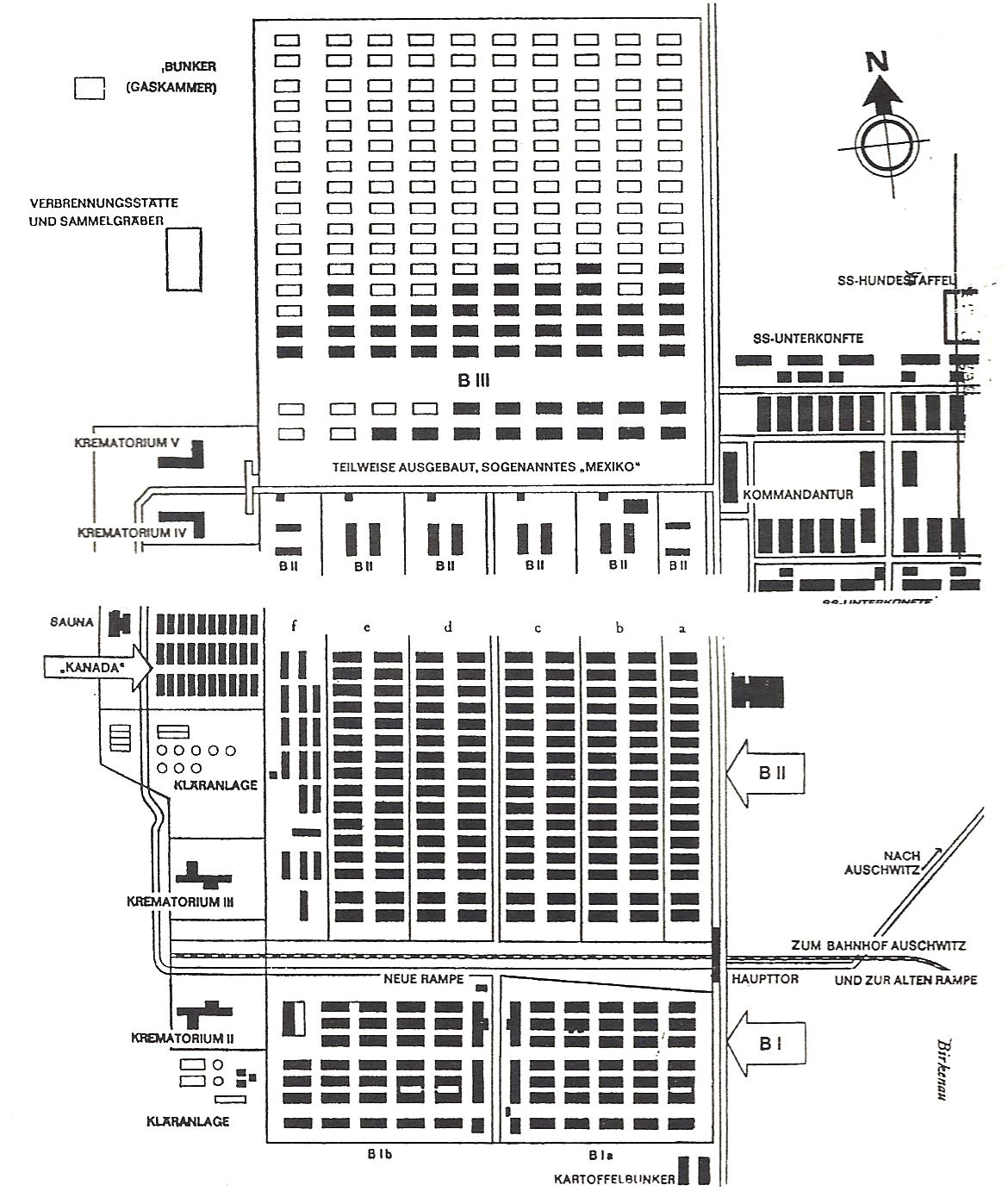
Figure 2: Plan of Birkenau (Auschwitz II) (from G. Wellers, Les chambres à gas ont existé)

Figure 3: Arrival of a convoy at the Birkenau ramp. (from Casaril, L’Album d’Auschwitz)

Figure 4: Women on the Birkenau ramp. Crematorium III is in the background. (from Casaril, L’Album d’Auschwitz)

Figure 5: Plan of crematorium II at Birkenau. (from AAVV, Les chambres à gas secret d’Etat)
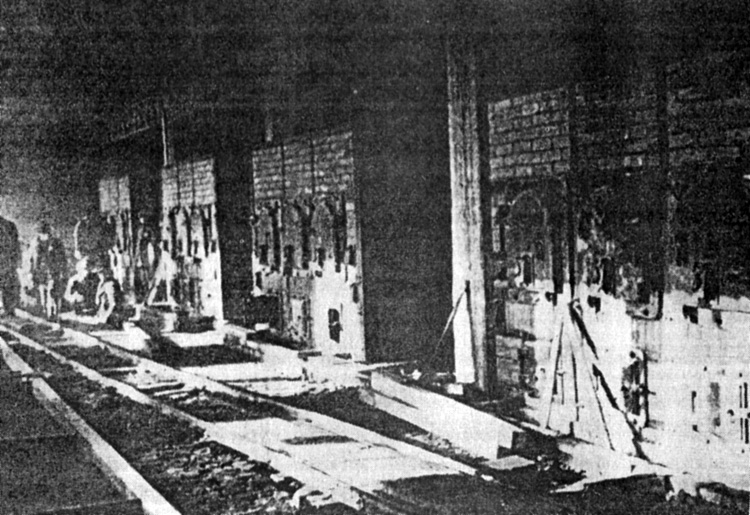
Figure 6: Crematory room of crematorium II or III (while under construction). (from KL Auschwitz)

Figure 7: Plan of crematorium III (crematorium II was its mirror image) (from Müller, Eyewitness Auschwitz: Three Years in the Gas Chambers)
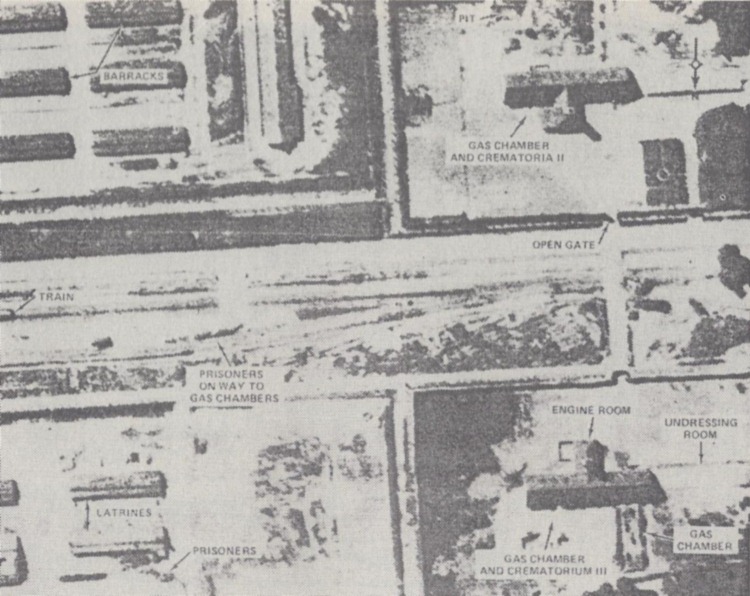
Figure 8: Aerial photograph taken by the U.S. Army Air Force on August 25, 1944. (from Brugioni and Poirier, The Holocaust Revisited)

Figure 8a : Enlargement of the preceeding photograph (Figure 8) showing details of crematorium II. (from Brugioni and Poirier, The Holocaust Revisited)
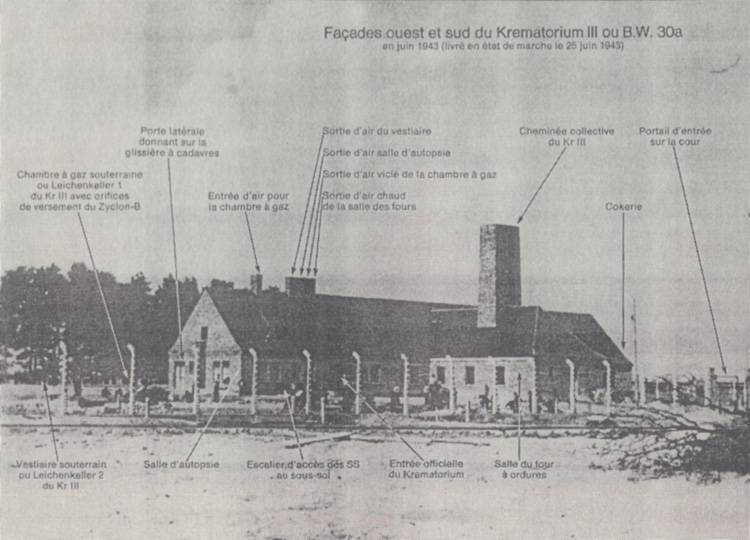
Figure 9: South and West facades of crematorium III. (from Casaril, L’Album d’Auschwitz)

Figure 10 : Nuremberg document NO-4473

Figure 11 : The “proof of proofs” according to Pressac and Klarsfeld. (from VSD (Vendredi-Samedi-Dimanche))
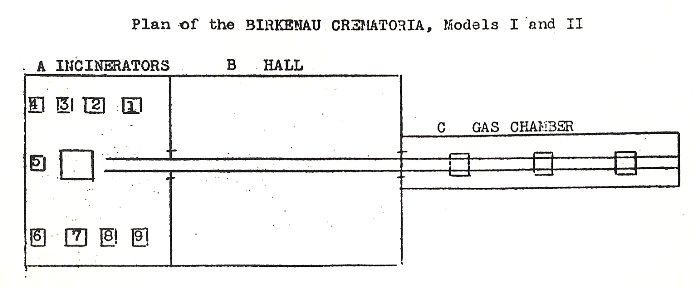
Figure 12 : Plan of crematorium II and III of Birkenau, according to Wetzler. (from the U.S. National Archives, Washington, D.C OSS-C.I.D. XL8883)
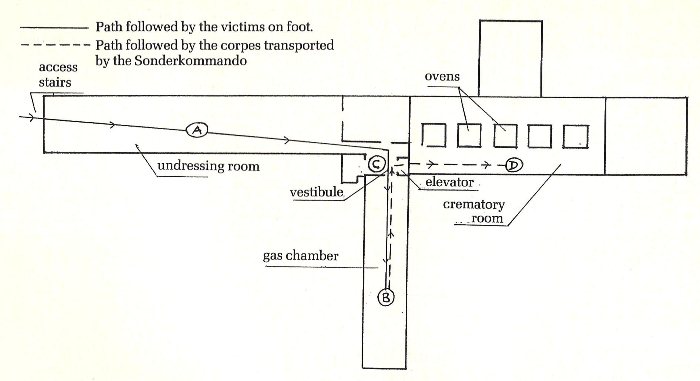
Figure 13 : Route followed by the victims, according to the official thesis. (drawing by the author)


Figure 14 : Reconstruction of the “extermination process” according to the Auschwitz Museum. (from Stäglich, The Auschwitz Myth)

Figure 15 : Diagram illustrating the effectiveness of the circulatory system. (from DEGESCH, Fumigration Chambers for Pest Control)

Figure 16 : Elevation drawing of a delousing chamber with a DEGESCH circulatory system. (from F.P. Berg, “The German Delousing Chambers,” The Journal of Historical Review)

Figure 17 : Plan of a vacuum fumigation plant, Casablanca (Morocco). (from DEGESCH, Fumigration Chambers for Pest Control)
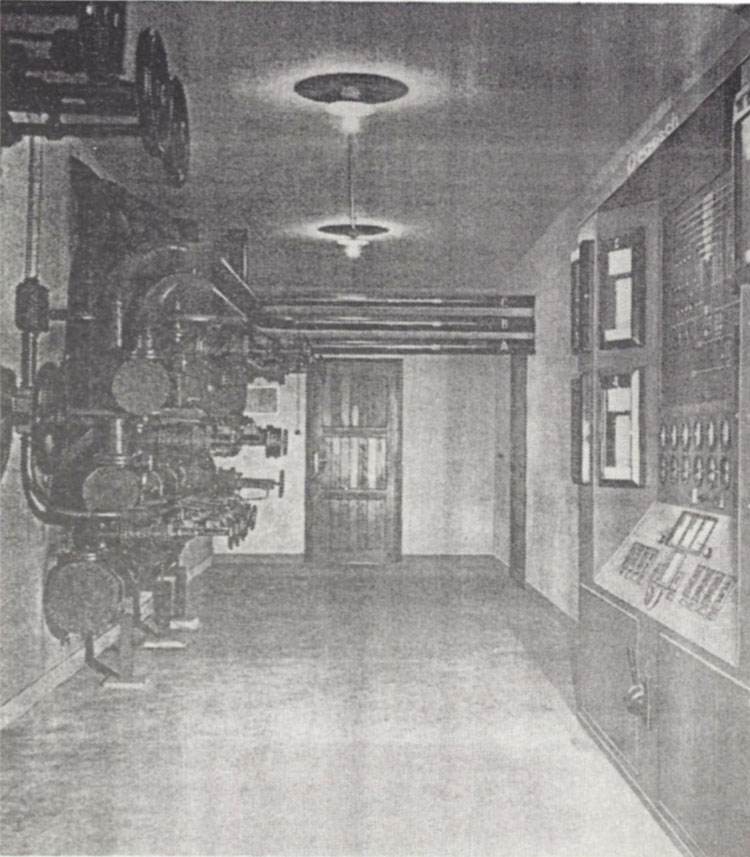
Figure 17a : Vacuum fumigation plant, Casablanca (Morocco). Control room with control panel and control valves. (from DEGESCH, Fumigration Chambers for Pest Control)

Figure 18 : Zyklon containers and their contents: snippets and wooden discs impregnated with hydrogen cyanide. (from DEGESCH, Zyklon for Pest Control)

Figure 19 : Fumigation with Zyklon (from DEGESCH, Zyklon for Pest Control)
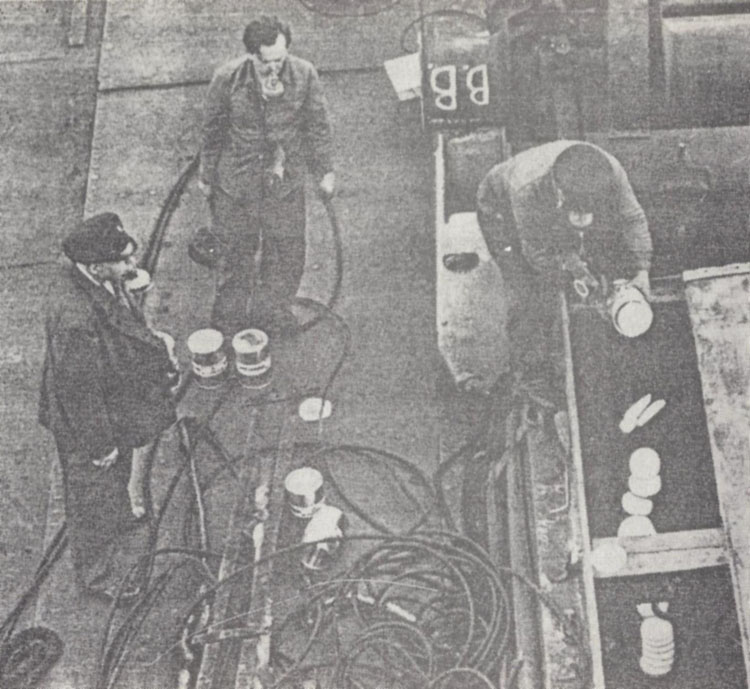
Figure 20: Fumigation of a ship’s hold with Zyklon (from DEGESCH, Zyklon for Pest Control)
From The Journal of Historical Review, Fall 1988 (Vol. 8, No. 3), pp. 303-358.
This article was translated by Tom Kerr.
About the Author
Enrique Aynat Eknes was born in Spain in 1954. He holds a Bachelor of Law degree. He is the author of El Diario ABC y El Holocausto, a study of a leading Spanish daily newspaper’s wartime coverage of the “Holocaust,” and of “Los ‘Protocolos de Auschwitz’: ¿Una fuente histórica?” (“The “Auschwitz Protocols’: A Historical Source?”), a study of the first detailed investigations of homicidal gassings at Auschwitz.